

How To Create A Template In Power Point
When you create a presentation and then salve it as a PowerPoint template (.potx) file, you can share it with your colleagues and reuse it again. To create a template, yous'll need to modify a slide master and a set of slide layouts.
Choose from thousands of free templates to download at Microsoft templates
Click a heading below to open the section and see detailed instructions:
-
Open a blank presentation: File > New > Blank Presentation
-
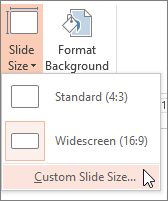
On the Design tab, select Slide Size > Custom Slide Size and choose the page orientation and dimensions you desire.
-
On the View tab, in the Master Views group, choose Slide Primary.
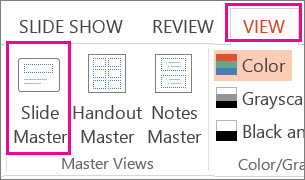
The slide chief is the largest slide image at the tiptop of the slide thumbnail list, to the left of your slides. Associated slide layouts are positioned beneath the slide master.

-
To make changes to the slide master or slide layouts, on the Slide Principal tab, practise whatever of the following:
-
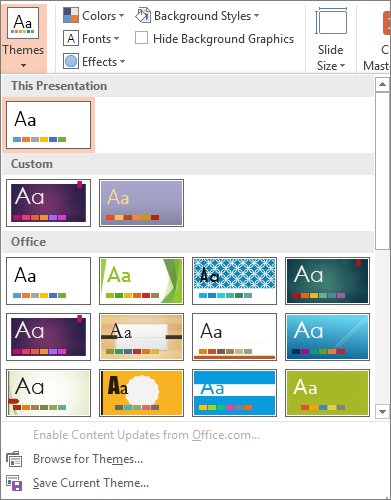
To add a colorful theme with special fonts and effects, click Themes, and choose a theme from the gallery. Use the scrollbar on the right to encounter more themes.
-
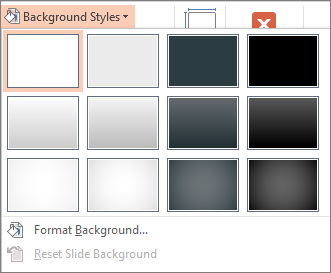
To change the background, click Groundwork Styles, and choose a background.
-
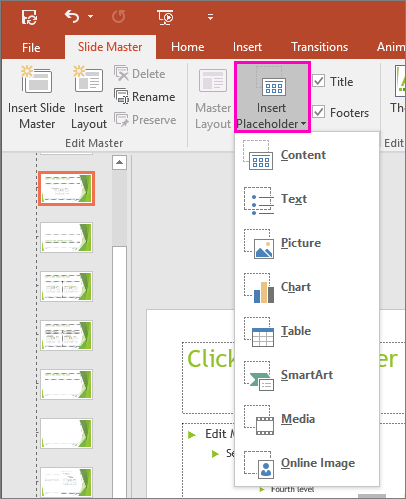
To add a placeholder (to agree text, a picture, chart, video, audio, and other objects), in the thumbnail pane, select the slide layout that you want to hold the placeholder, and do the following:
-
Click Insert Placeholder, and select the type of placeholder y'all want to add.
-
On the slide primary or slide layout, click and elevate to draw the placeholder size.
Tip: To resize a placeholder, drag the corner of one of its borders.
-
-
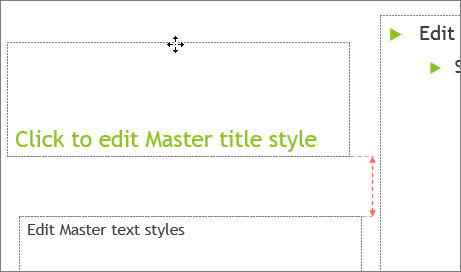
To move a placeholder around on a slide master or slide layout, select the edge and and so drag it into a new position.
-
To remove an unwanted placeholder in a slide chief or slide layout, select it in the slide thumbnail pane, and and then select the border of the placeholder on the slide and printing Delete.
-
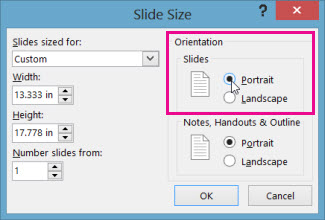
To set the folio orientation for all of the slides in your presentation, click Slide Size > Custom Slide Size.
Under Orientation, choose Portrait or Landscape.
-
-
On the File tab, click Salvage Every bit (or Salvage a Re-create, if you are using Microsoft 365).
-
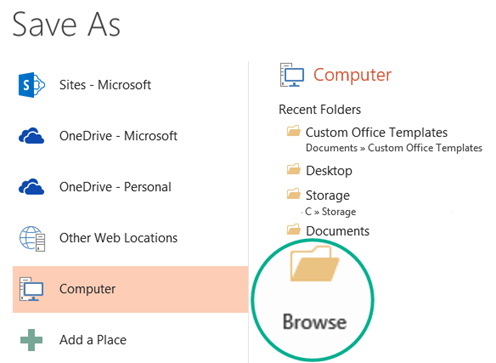
Under Save, click Browse to open the Relieve Every bit dialog box.
-
In the Salve Equally dialog box, in the Save as type listing, cull PowerPoint Template.
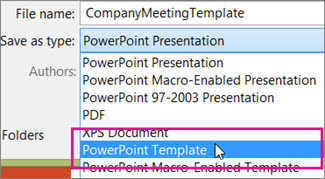
When y'all choose the "template" blazon, PowerPoint automatically switches the storage location to the appropriate binder, the Custom Office Templates binder.
-
In the Save As dialog box, in the File name box, type a file name for your template, or practise nothing to accept the suggested file proper noun.
-
Select Relieve.
-
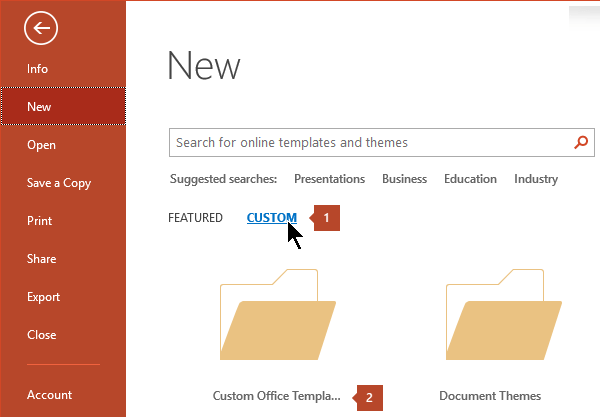
To use your template for a new presentation, click File > New. And so click Custom > Custom Function Templates, and then double-click the template you saved.
See Also
Create your ain theme in PowerPoint
Relieve a slide design (theme) every bit a template
Edit, change, or delete a placeholder
What is a slide chief?
What is a slide layout?
Create and apply your own template in Role for Mac
Important: Role 2010 is no longer supported. Upgrade to Microsoft 365 to work anywhere from any device and continue to receive support.
Upgrade at present
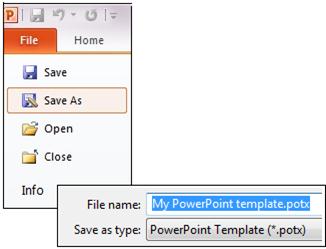
On the File tab, click Salve As, in the File name box give your template a name, and then in the Save as type box, select PowerPoint Template (*.potx).
Click a heading below to open up the department and see the instructions:
To brainstorm creating the template that you lot'll use in your presentation, do the following:
-
Open a bare presentation.
-
On the Design tab, select Page Setup, and choose the orientation and folio dimensions you desire.
-
On the View tab, in the Master Views grouping, click Slide Principal.
Tip: In Slide Master view, in the slide thumbnail pane, the slide master represents the larger slide paradigm, and the associated layouts are smaller, positioned beneath information technology.
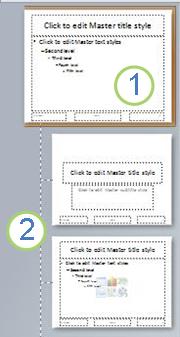
1. Slide principal
2. Associated layouts
-
To customize the slide master and associated layouts, do one or more of the following:
-
To remove an unwanted, default placeholder from a layout, in the slide thumbnail pane, click the slide layout that contains the placeholder, click the border of the placeholder in the presentation window, and then press DELETE.
-
To add a text placeholder, in the slide thumbnail pane, click the slide layout that y'all want to contain the placeholder, and and so exercise the following:
-
On the Slide Main tab, in the Master Layout group, click Insert Placeholder, and and so click Text.
-
Click a location on the slide master, and and then drag to draw the placeholder.
Tip: To resize a placeholder, elevate the corner of i of its borders.
-
Type descriptive text that prompts the users of your template to enter specific information.
-
-
To add other types of placeholders that comprise content such as pictures, prune art, screen shots, SmartArt graphics, charts, movies, sounds, and tables, on the Slide Primary tab, in the Main Layout group, click Insert Placeholder, and then click the type of placeholder that you want to add.
-
To add grapheme past using color and a background, exercise one of the following:
-
To apply a theme (to include colour, formatting, furnishings, in a layout) to your presentation, on the Slide Master tab, in the Edit Theme group, click Themes, and so select a theme.
-
To change the background, on the Slide Master tab, in the Background group, click Groundwork Styles, and then select a background.
-
-
-
To save your template, click the File tab, then click Save As.
-
In the File proper name box, type a file name, or do null to have the suggested file proper noun.
-
In the Save every bit blazon listing, click PowerPoint Template (.potx).
When you choose the "template" blazon, PowerPoint automatically switches the storage location to the appropriate binder, the \Program Files\Microsoft Office\Templates\ folder.
-
Select Relieve.
-
To use your template for a new presentation, click File > New. And so click My templates. In the New Presentation dialog box, select the template you saved, and click OK.
If you need assistance applying your new template to a presentation, come across Apply a template to your presentation.

Links to more information about PowerPoint templates
-
Utilize a template to your presentation
-
Understand the divergence between PowerPoint templates and themes
-
What is a slide master?
-
What is a slide layout?
Of import: Role 2007 is no longer supported. Upgrade to Microsoft 365 to work anywhere from whatever device and keep to receive support.
Upgrade now
To apply a new or different PowerPoint 2007 template that already exists, see Use a template to your presentation.
All-time practice for creating a template
When yous create a template, add together whatsoever content to the slide chief in Slide Master view that you lot want to protect from beingness changed by users of your template, such every bit instructional prompt text, logos, header and footer information, discipline thing content, a background, formatting, colors, fonts, and furnishings.
Users of your template volition work in Normal view, guided by the instructional prompts that yous added. The template users will replace the instructional prompt text and other placeholder content with data that is specific to their own project or presentation.
-
Open a blank presentation.
-
On the Design tab, select Page Setup, and choose the orientation and page dimensions you want.
-
On the View tab, in the Presentation Views group, click Slide Chief.
-
On the Slide Master tab, in the Edit Master group, click Insert Slide Chief.
Notes:
-
In the slide thumbnail pane, the slide master represents the larger slide image, and the associated layouts are positioned beneath it.
-
Many presentations contain more one slide master, so yous may have to scroll to detect the one that you want.
-
-
To begin customizing the slide master, do 1 or more of the post-obit:
-
To remove whatsoever of the built-in slide layouts that accompany the default slide master, in the slide thumbnail pane, right-click each slide layout that you lot don't want to employ, and then click Delete Layout.
-
To remove an unwanted, default placeholder, in the slide thumbnail pane, click the slide layout that contains the placeholder, click the border of the placeholder in the presentation window, and so press DELETE.
-
To add a text placeholder, in the slide thumbnail pane, click the slide layout that you lot want to incorporate the placeholder, and then practise the following:
-
-
On the Slide Master tab, in the Master Layout group, click Insert Placeholder, and so click Text.
-
Click a location on the slide master, and then drag to depict the placeholder.
Tip: To resize a placeholder, drag the corner of ane of its borders.
-
Type descriptive text that prompts the users of your template to enter specific information.
-
To add together other types of placeholders that contain content such equally pictures, prune art, SmartArt graphics, charts, movies, sounds, and tables, on the Slide Main tab, in the Principal Layout group, click the blazon of placeholder that you lot want to add.
-
To apply a theme (to include color, formatting, effects, in a layout) to your presentation, on the Slide Main tab, in the Edit Theme group, click Themes, and then click a theme.
-
To change the groundwork, on the Slide Master tab, in the Groundwork grouping, click Groundwork Styles, and so click a background.
-
To set the page orientation for all of the slides in your presentation, on the Slide Main tab, in the Page Setup group, click Slide Orientation, and then click either Portrait or Mural.
-
To add text to appear in the footer at the bottom of all of the slides in your presentation, practice the following:
-
On the Insert tab, in the Text grouping, click Header & Footer.
-
In the Header and Footer dialog box, on the Slide tab, select the Footer cheque box, so type the text that you desire to appear at the bottom of your slides.
-
To display the footer content on all slides, click Apply to All.
For more information about using footers, see Show footer information on your slides.
-
-
-
Click the Microsoft Office Button
 , and then click Relieve As.
 -
In the File name box, type a file name, or exercise cypher to take the suggested file name.
-
In the Save as type list, click PowerPoint Template (*.potx).
When y'all choose the "template" type, PowerPoint automatically switches the storage location to the appropriate folder, the \Program Files\Microsoft Office\Templates\ folder.
-
Select Save.
-
If you lot need help applying your new template to a presentation, see Utilise a template to a new presentation.
Use a template to a new presentation
See Apply a template to your presentation.
You lot can't create a template in PowerPoint for the web. You take to apply a desktop version of PowerPoint instead.

How To Create A Template In Power Point,
Source: https://support.microsoft.com/en-us/office/create-and-save-a-powerpoint-template-ee4429ad-2a74-4100-82f7-50f8169c8aca
Posted by: connobtionve.blogspot.com
0 Response to "How To Create A Template In Power Point"
Post a Comment